-

-

+86-18858010843

NdFeB magnets — sintered neodymium-iron-boron permanent magnets — are the most powerful commercially available permanent magnets in the world, with energy products ranging from 35 MGOe (N35) up to 52 MGOe (N52) and beyond. They are the critical enabling material for modern electric motors, industrial automation, medical devices, renewable energy systems, and consumer electronics. Whether you are sourcing from a neodymium magnets manufacturer for high-volume motor production or need custom NdFeB magnets for a precision instrument, understanding what NdFeB magnets are used for is the foundation of making the right material and grade selection.
Ningbo Tujin Magnetic Industry Co., Ltd. is a professional NdFeB magnets manufacturer and rare earth magnets factory specializing in high-performance, high-temperature motor magnets and precision custom shapes for demanding global applications. This guide covers the full scope of NdFeB magnet applications, grades, compositions, coatings, and design considerations.
The term NdFeB stands for Neodymium (Nd), Iron (Fe), and Boron (B) — the three primary constituents of the alloy. The dominant magnetic phase is Nd2Fe14B, a tetragonal intermetallic compound first synthesized independently by General Motors and Sumitomo Special Metals in 1984. The NdFeB magnet meaning in practice is a sintered or bonded permanent magnet with the highest known energy product of any magnetic material at room temperature.
NdFeB magnet composition by weight is approximately 29–32% neodymium (a rare earth element), 64–68% iron, and 1% boron, with small additions of dysprosium (Dy), terbium (Tb), cobalt (Co), aluminum (Al), copper (Cu), and niobium (Nb) to optimize coercivity, temperature stability, and grain boundary microstructure. High-temperature NdFeB magnets contain elevated levels of Dy or Tb — heavy rare earth additions that significantly improve the magnet's resistance to demagnetization at elevated operating temperatures, making them essential for NdFeB magnets for motors in new energy vehicles and industrial drives.
| Element | Symbol | Typical Content | Primary Function |
|---|---|---|---|
| Neodymium | Nd | 29–32 wt% | Primary magnetic phase former (Nd2Fe14B) |
| Iron | Fe | 64–68 wt% | Provides high saturation magnetization |
| Boron | B | ~1 wt% | Stabilizes tetragonal crystal structure |
| Dysprosium | Dy | 0–6 wt% | Increases coercivity for high-temp grades |
| Terbium | Tb | 0–2 wt% | Alternative HRE addition, higher coercivity/atom |
| Cobalt | Co | 0–3 wt% | Improves Curie temperature and corrosion resistance |
The NdFeB magnet grades system classifies magnets primarily by their maximum energy product (BHmax), expressed in MGOe (Mega Gauss Oersteds) or kJ/m3. Standard grades range from N35 to N52, with higher numbers indicating greater magnetic energy density. Grade suffixes — H, SH, UH, EH, AH — indicate progressively higher maximum operating temperatures and coercivity levels.
The chart above presents two key axes of NdFeB magnet specification: energy product by base grade (N35–N52, shown in red) and maximum operating temperature by grade suffix (N through NUH, shown in blue). N52 neodymium magnets deliver the highest energy product of any commercially produced sintered NdFeB grade, offering up to 52 MGOe — roughly 50 percent more magnetic energy per unit volume than N35. This makes N52 neodymium magnet block formats particularly valued in space-constrained high-performance motor designs. The temperature suffix system is equally critical for motor applications: standard N-grade magnets are rated to only 80 degrees Celsius, while NUH and NEH grades withstand 180 to 200 degrees Celsius — a specification essential for EV traction motors, servo drives, and compressor motors where winding temperatures can exceed 150 degrees Celsius. Selecting the correct grade combination of energy product and temperature class is the first and most important step in custom NdFeB magnet specification.
The question of what are neodymium magnets used for has an expansive answer that spans virtually every technology-intensive industry. As a rare earth magnets manufacturer, Tujin Magnetic Industry supplies NdFeB magnets across the following primary sectors:
NdFeB magnets for motors represent the single largest application segment, accounting for an estimated 60 to 65 percent of global NdFeB consumption by value. In electric vehicles, permanent magnets for electric motors — specifically interior permanent magnet synchronous motors (IPMSM) — enable power densities unachievable with induction or wound-field alternatives. A typical 150kW EV traction motor uses approximately 2 to 4 kg of high-grade sintered NdFeB. Motor grade neodymium magnets for EV applications typically require grades such as 38UH, 40UH, or 42SH, combining high remanence with sufficient coercivity to resist demagnetization at peak operating temperatures.
Custom motor magnets for industrial automation include arc segment magnets for servo motor rotors, ring magnets for BLDC (Brushless DC) stators, and high-coercivity blocks for magnetic separators and holding assemblies. Rare earth magnets for motors in servo and robotic joint applications demand extremely tight dimensional tolerances — typically ±0.05mm on critical dimensions — and consistent magnetic properties across large production batches to ensure uniform torque ripple characteristics.
Energy-efficient compressor motors for air conditioners, inverter washing machine motors, and variable-speed fan motors all rely on sintered neodymium magnets to achieve their efficiency ratings. In the audio sector, NdFeB magnets in speakers deliver superior sensitivity and transient response compared to ferrite alternatives. Sensor magnets in encoders, position sensors, and automotive throttle bodies are another high-volume application for custom NdFeB magnets in compact geometries.
Medical applications include micro-motors for dental implant handpieces, surgical robot joint drives, insulin pump motors, and catheter steering systems. These applications demand the highest levels of dimensional precision, surface finish, and batch-to-batch magnetic consistency. As a NdFeB magnets supplier serving medical customers, Tujin provides full material traceability and inspection documentation including Br, Hcj, BHmax, and coating thickness records for each production batch.
Direct-drive wind turbine generators are a major and growing application for large-format rare earth magnets. A 5MW direct-drive offshore wind turbine may require more than 2,000 kg of sintered NdFeB in its generator rotor. As wind turbines scale toward 12MW and beyond, demand for high-performance permanent magnets from neodymium magnets factories with proven large-format manufacturing capability continues to increase.
The horizontal bar chart above shows the estimated demand distribution of NdFeB magnets across key end-use industries. EV and motor applications together represent approximately 40 percent of total NdFeB demand, reflecting the accelerating transition to electrified transport and the central role of permanent magnet motors in EV powertrain architecture. Industrial automation accounts for 24 percent — a segment driven by the global expansion of factory robotics, servo press systems, and precision CNC equipment — all of which rely on high-torque motor magnets to deliver the accuracy and responsiveness that automated manufacturing requires. Wind power's 16 percent share is expected to grow substantially through 2030 as direct-drive turbine designs gain market share over geared alternatives. Medical and precision device applications, while smaller in volume, are among the most demanding in terms of dimensional tolerance and magnetic uniformity, making them a priority focus for specialized custom NdFeB magnet producers. The breadth of this demand profile underscores why NdFeB magnets manufacturer capabilities across grades, shapes, and coatings are so important for serving multiple industries from a single production platform.
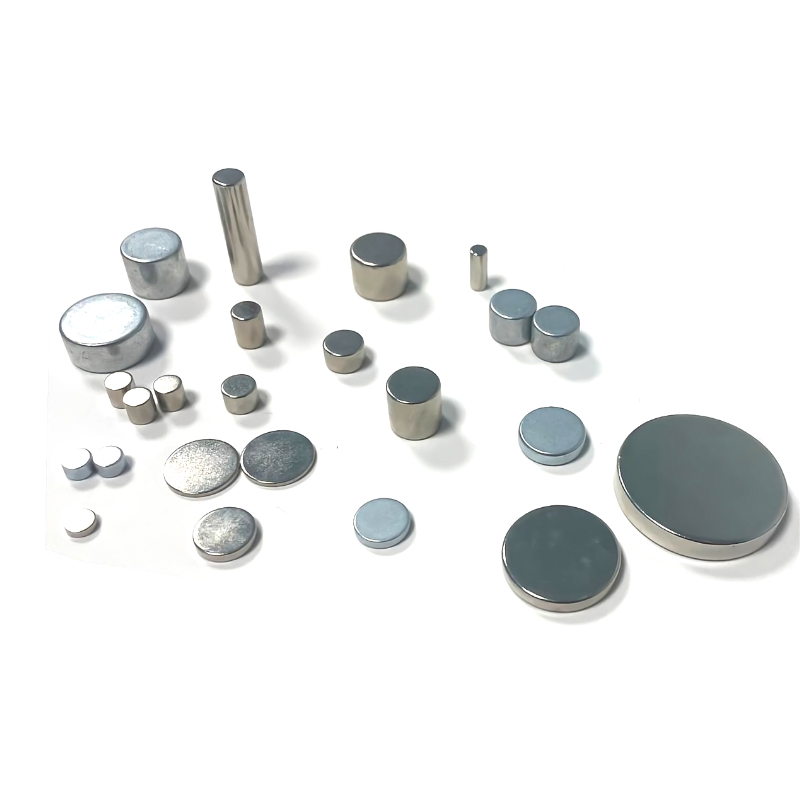
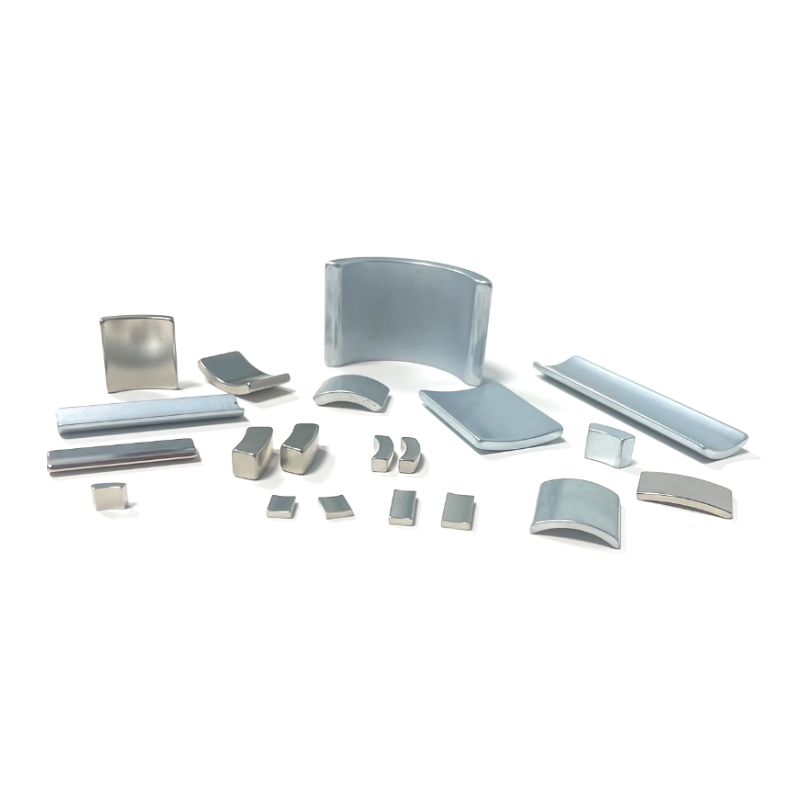
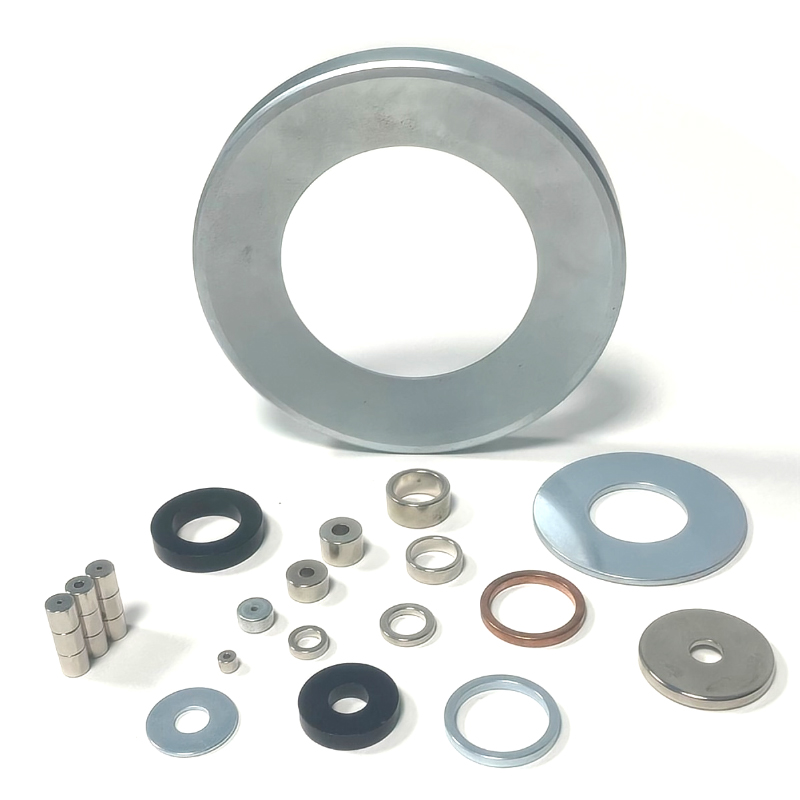
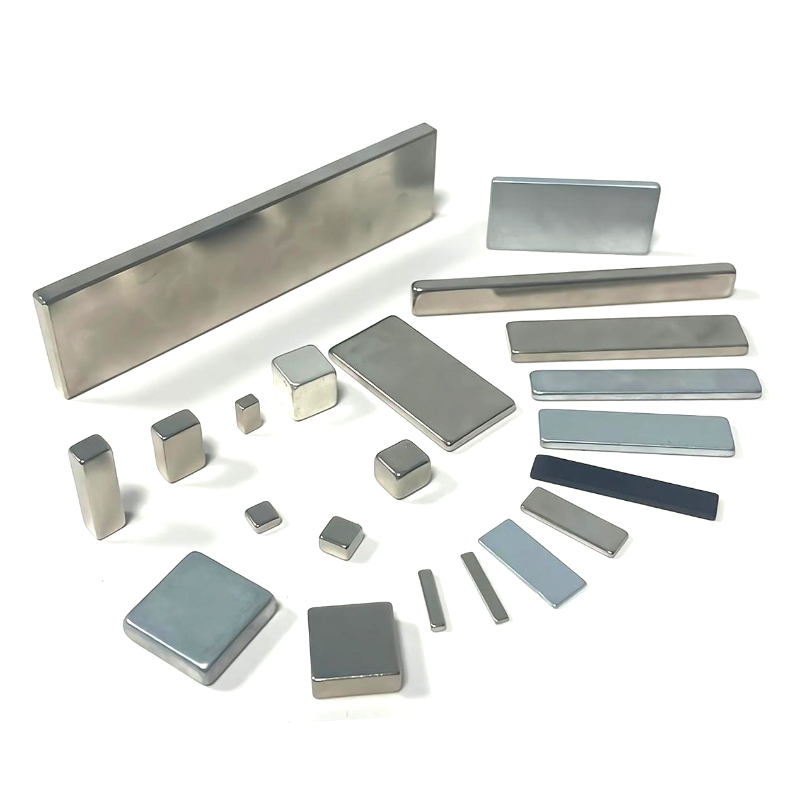
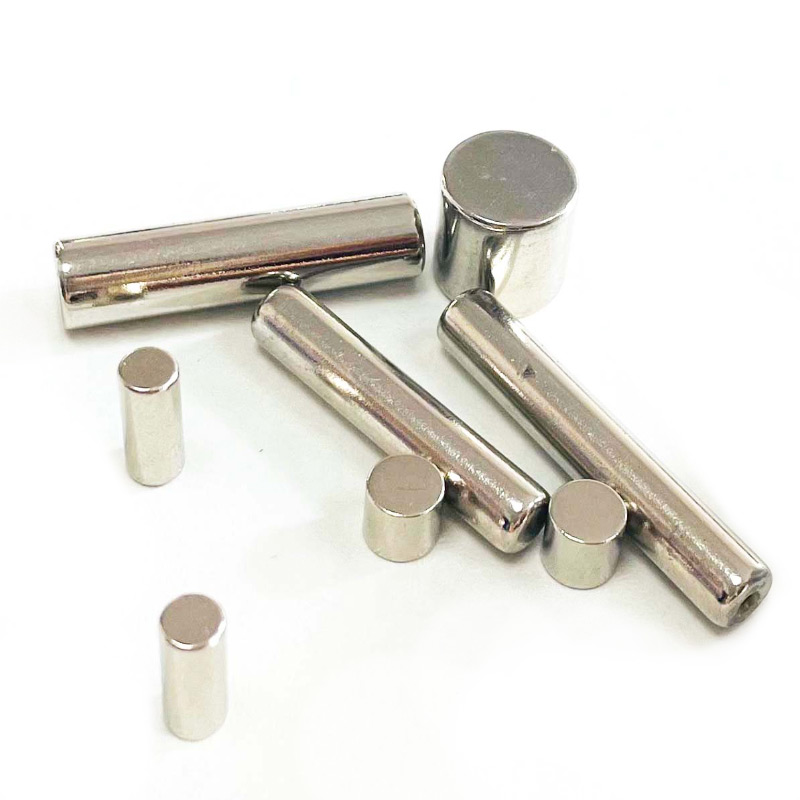
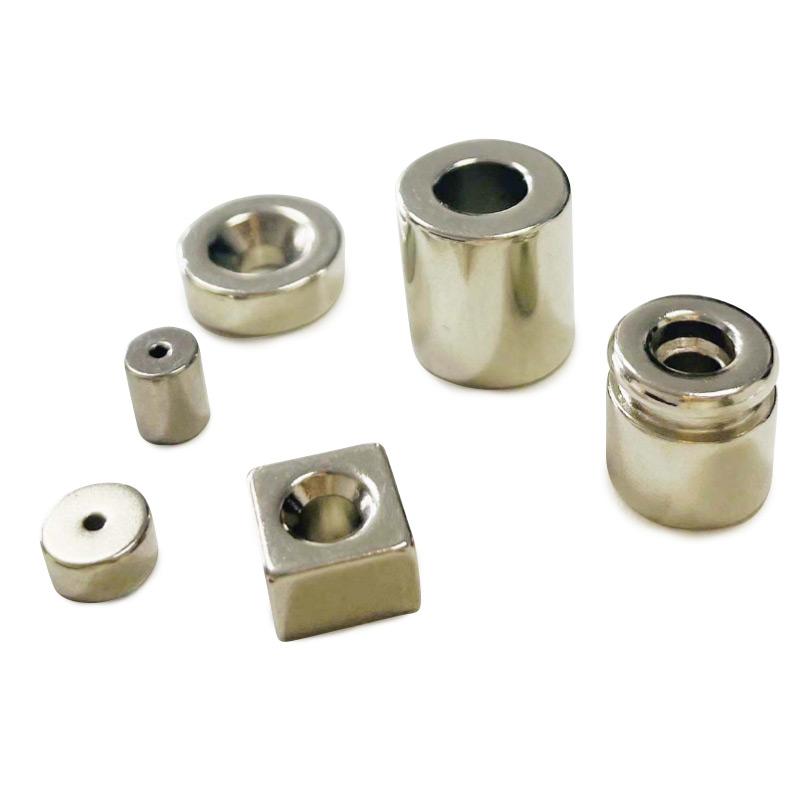
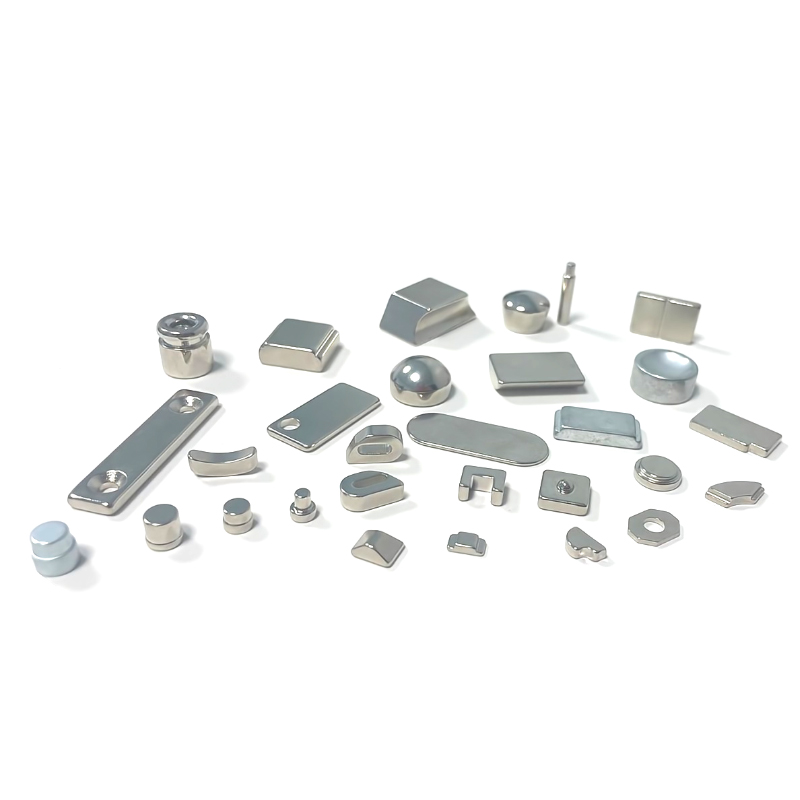
As a leading custom neodymium magnets producer, Tujin Magnetic Industry manufactures a comprehensive range of magnet geometries to satisfy the magnetic circuit requirements of diverse motor and device designs. The following product images illustrate the breadth of precision shapes available from our NdFeB magnets factory:
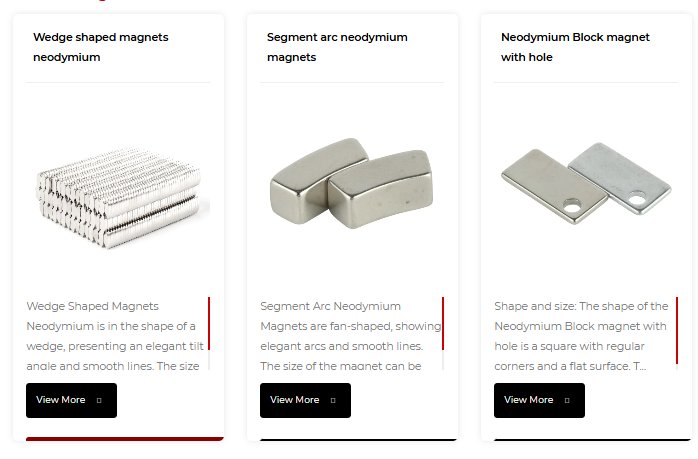
Wedge shaped neodymium magnets, segment arc NdFeB magnets, and block magnets with hole — custom shapes from Tujin Magnetic Industry
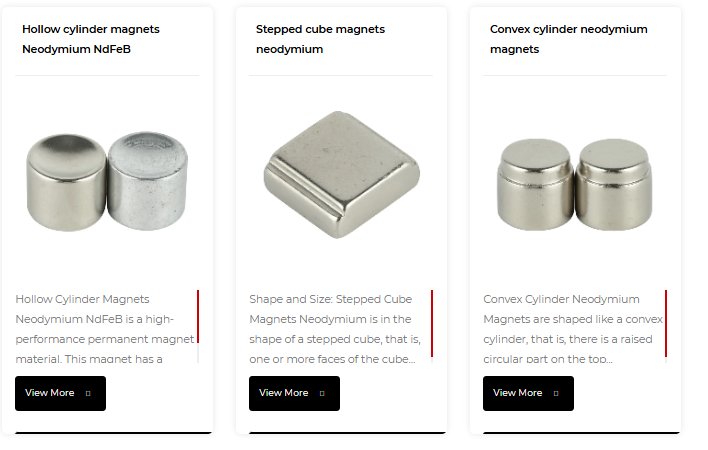
Hollow cylinder NdFeB magnets, stepped cube neodymium magnets, and convex cylinder permanent magnets for motor and precision device applications
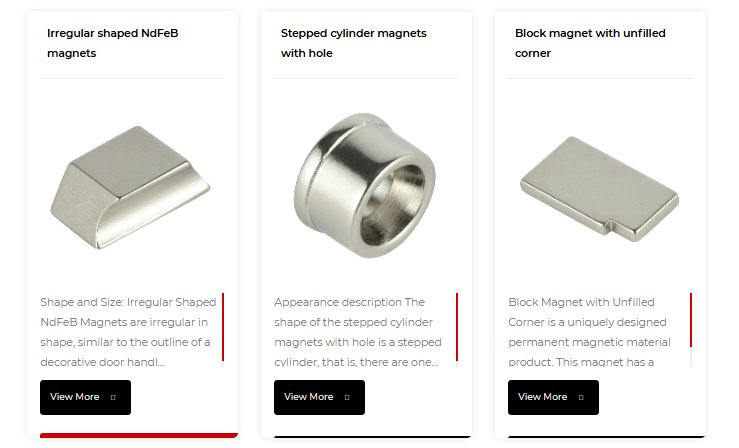
Irregular shaped NdFeB magnets, stepped cylinder magnets with hole, and block magnets with unfilled corner — designed to exact customer specifications
Segment arc magnets are the most widely used geometry for surface-mounted and interior permanent magnet motor rotors. Precision grinding ensures arc radius and angular dimensions are held within ±0.03mm, critical for consistent air gap flux density and low torque ripple. Wedge-shaped magnets are used in Halbach array configurations and certain linear motor designs. Hollow cylinder and ring magnets with multi-pole magnetization are common in encoder wheels, coupling assemblies, and compact BLDC motors. Irregular and stepped shapes — including block magnets with unfilled corners, convex cylinders, and stepped cylinders with holes — are produced to exact customer CAD specifications, enabling design engineers to optimize magnetic circuits without being constrained by standard catalog geometries.
Temperature is the most critical performance variable for NdFeB magnets for motors. Unlike ferrite magnets, which have positive temperature coefficients of coercivity, NdFeB magnets lose coercivity as temperature rises — a phenomenon described by the temperature coefficients of Br (typically -0.09 to -0.12% per degree Celsius) and Hcj (typically -0.40 to -0.60% per degree Celsius for standard grades). If operating temperature exceeds the knee point of the demagnetization curve, irreversible flux loss occurs.
Tujin's high-temperature NdFeB magnets maintain reliable magnetic performance across the full operating range of -40 degrees Celsius to 200 degrees Celsius or above. Advanced grain boundary diffusion (GBD) technology — in which Dy or Tb is diffused selectively into grain boundaries rather than bulk-added — allows coercivity enhancement with minimal sacrifice of remanence, enabling high torque motor magnets that outperform conventional heavy-rare-earth-substituted grades in both cost and performance.
The line chart illustrates how remanence retention degrades with increasing operating temperature across three NdFeB grade variants of the same base energy class: N42, N42H, and N42UH. Standard N42 magnets experience irreversible demagnetization above 80 degrees Celsius, making them unsuitable for motor applications where winding temperatures can exceed this threshold under continuous load. N42H, with its higher intrinsic coercivity achieved through controlled dysprosium addition, extends the usable range to approximately 120 degrees Celsius — adequate for many industrial servo and appliance motor applications. N42UH magnets maintain useful flux levels up to 180 degrees Celsius, making them the grade of choice for EV traction motors, aerospace actuators, and high-cycle industrial drives. The steeper the application's thermal gradient, the more critical it becomes to work with a neodymium magnets manufacturer who can provide both the correct grade specification and the validation test data — including thermal demagnetization curves measured on actual production batches — to confirm performance in the intended operating environment. Tujin provides complete magnetic characterization data with every motor magnet shipment.
Uncoated sintered NdFeB magnets are susceptible to corrosion due to the electrochemical interaction between the Nd2Fe14B phase and the neodymium-rich grain boundary phase. Without appropriate surface protection, oxidation leads to spalling, magnetic flux loss, and contamination of surrounding assemblies. Advanced coatings are therefore a critical quality differentiator for any custom NdFeB magnets manufacturer serving motor and industrial applications.
As a rare earth magnets factory with full in-house coating capability, Tujin Magnetic Industry selects and validates the optimal coating system for each customer application, ensuring that surface protection performance is verified through accelerated corrosion testing before mass production commences.
A complete NdFeB magnet datasheet provides the magnetic, thermal, and physical parameters needed to fully characterize a magnet for engineering design. The following table summarizes the key parameters and their typical value ranges for sintered NdFeB:
| Parameter | Symbol | Typical Range (N35–N52) | Engineering Significance |
|---|---|---|---|
| Remanence | Br | 1.17–1.48 T | Air gap flux density; directly drives motor torque |
| Coercivity (intrinsic) | Hcj | 955–2000 kA/m | Demagnetization resistance; critical for high-temp use |
| Energy Product | BHmax | 263–414 kJ/m3 | Overall magnetic strength per unit volume |
| Curie Temperature | Tc | 310–380 C | Absolute magnetic saturation limit (not operating temp) |
| Temp. Coeff. of Br | alpha(Br) | -0.09 to -0.12 %/C | Reversible flux variation with temperature |
| Density | rho | 7.4–7.6 g/cm3 | Mass estimation for rotor balance calculations |
The radar chart compares sintered NdFeB, ferrite, and Alnico magnets across six key performance dimensions relevant to motor and industrial applications. NdFeB dominates in remanence, energy product, and coercivity — the three properties that determine how much torque a motor can produce per unit of magnet volume, and how resistant it is to demagnetization under adverse field conditions. Ferrite magnets score highest on corrosion resistance and cost efficiency, making them appropriate for simple, low-power applications in benign environments, but their energy product is typically 5 to 8 times lower than equivalent-volume NdFeB, severely limiting their suitability for high torque motor magnets. Alnico magnets — an iron-aluminum-nickel-cobalt alloy — offer excellent temperature stability and are used in specialized sensors and analog instruments, but their extremely low coercivity makes them vulnerable to demagnetization in the stray fields of motor assemblies, limiting their use as permanent magnets for electric motors. For demanding motor applications, NdFeB from a qualified rare earth magnets manufacturer with appropriate grade selection and coating is the technically superior choice across most key performance dimensions.
For import and export purposes, the NdFeB magnet HS code typically falls under HS 8505.11 — permanent magnets of metal — within the broader Harmonized System classification for electromagnets and permanent magnets (Chapter 85). Buyers sourcing from a NdFeB magnets factory in China should confirm the specific 10-digit HS code applicable in their jurisdiction, as sub-classifications vary between the EU Combined Nomenclature, US HTS Schedule, and other national tariff systems. Tujin Magnetic Industry provides full customs documentation support, including country of origin certificates, material composition declarations, and REACH/RoHS compliance statements.
NdFeB magnet recycling is an increasingly important topic as the global demand for rare earth elements grows and supply chain resilience becomes a strategic priority. Sintered NdFeB scrap — including production offcuts, rejected parts, and end-of-life motor magnets — can be reprocessed through hydrometallurgical or direct recycling routes to recover neodymium, dysprosium, and other valuable elements. The European Critical Raw Materials Act and equivalent policies in the US and Japan are establishing recycled content targets for rare earth magnets in EVs and wind turbines, creating a significant regulatory incentive for closed-loop recycling supply chains.
Ningbo Tujin Magnetic Industry Co., Ltd. is a professional NdFeB magnets manufacturer and rare earth magnets factory specializing in the manufacturing and sales of high-performance sintered neodymium-iron-boron magnets. With years of deep expertise in magnetic materials, Tujin excels in providing high-temperature-resistant motor magnets and customized magnetic solutions with superior precision and stability.
As a recognized neodymium magnets supplier to leading global brands, Tujin serves a wide range of industries including new energy vehicles, industrial automation, home appliances, medical precision devices, and energy equipment. Core product advantages include advanced high-temperature motor magnet technology operating from -40 degrees Celsius to 200 degrees Celsius and above; comprehensive custom shape capability spanning disc, block, arc segment, ring, rod, wedge, and complex irregular geometries; and premium coating systems including Ni-Cu-Ni, epoxy, zinc, and Parylene.
Renowned for exceptional product quality, fast lead times, and high production flexibility, Tujin has become a trusted long-term partner for leading companies across multiple industries worldwide. Whether you require standard N35 to N52 magnets in catalog shapes or fully custom NdFeB magnets engineered to precise drawing specifications, Tujin delivers professionalism, efficiency, and reliability to empower your products with superior magnetic performance.
Akılda bir plana sahip olmak, çok çalışmak ve ileriye doğru dövmek
 No.107 Yunshan Endüstri Parkı, Sanqishi Kasabası, Yuyao, Ningbo, Zhejiang 315412, Çin
 +86-18858010843

Copyright ? Ningbo Tujin Manyetik Endüstri A.Ş., Ltd. All Rights Reserved. Özel Nadir Toprak Mıknatıs Fabrikası